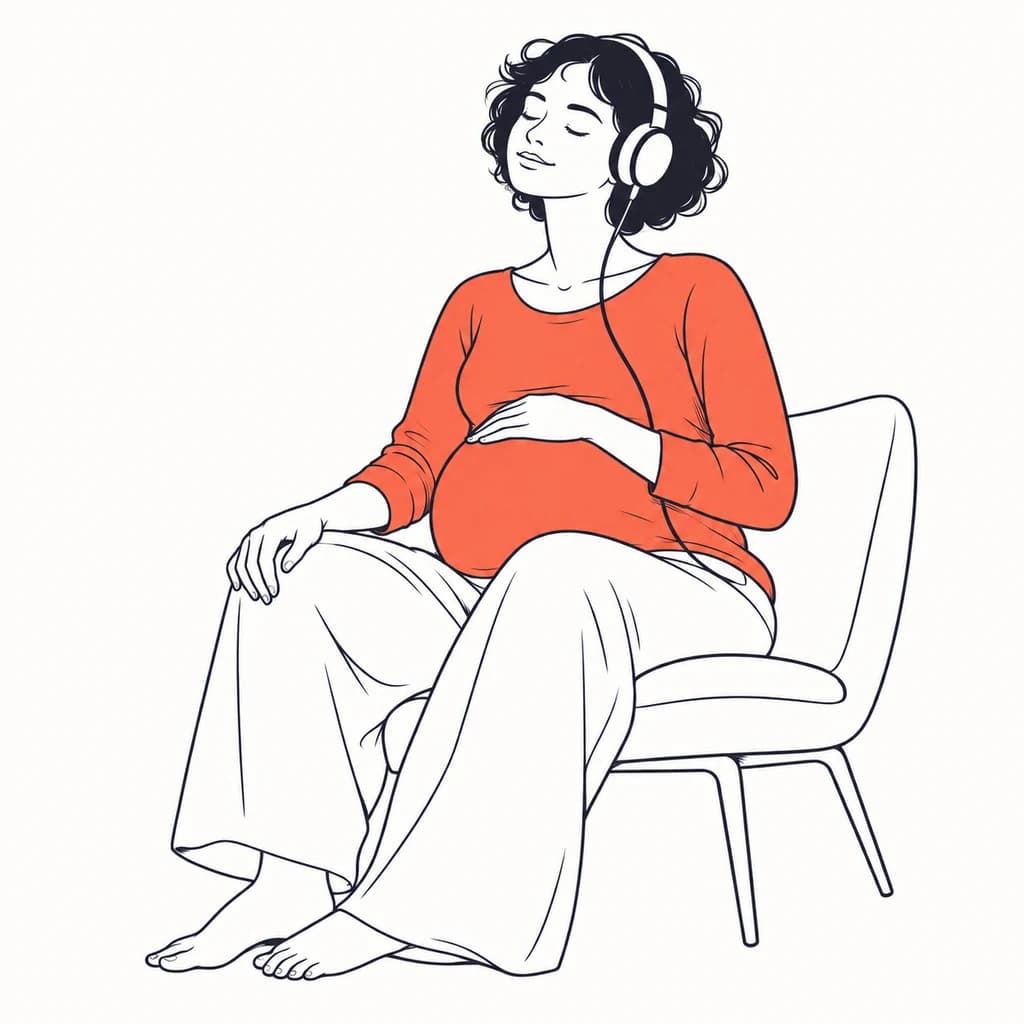
Making a supported nest
Welcome to Softening Each Surge. This is an invitation to explore yielding without asking you to ignore, rename or overcome what you feel.
Arrange pillows beneath your head, between your knees or wherever they offer support. Let the surface beneath you do some of the work. If you close your eyes, imagine heavy velvet curtains drawing across a stage while the noise of the room moves into the background.
Warm honey, moving slowly
Picture warm honey or golden oil above the crown of your head. Let it travel over your scalp and forehead, around your eyes and across your cheeks. Imagine it reaching the hinge of your jaw. You might let your lips part and your tongue rest, simply because that feels comfortable.
Follow the warmth down your neck and over your shoulders, then along your arms into open hands. Let it pass through your chest and across your belly without asking your breathing to become deeper than it wants to be.
Picture the warmth around your hips and pelvis, then down through your legs to your feet. If a rose image feels welcoming, imagine petals at the base of the body gently uncurling. This is relaxation imagery, not an instruction to make your cervix or pelvic floor behave in a particular way.
Finding a melt cue
Choose a simple cue such as ‘melt,’ ‘soft’ or ‘release.’ On an easy breath out, see whether your shoulders would like to lower, your jaw to rest or your hands to open. You do not have to become limp or remain still.
Try the cue once or twice: breathe in naturally, then let the out-breath arrive with the word you chose. Picture warm wax travelling down a candle. If extending the exhale is uncomfortable, return immediately to your usual breathing.
Your cue is not a switch that controls pain or labour. It is a familiar point of attention that you may choose alongside movement, sound, touch, water, medication and the support of your care team.
Three imagined waves
Picture a first wave forming in the distance. As it rises, notice your face. Let it look however it looks. If it helps, breathe out and use your cue. The wave reaches its height and moves on. Take the rest that follows.
A second wave gathers. This time, bring attention to your shoulders and hands. You might drop them, move them, hold someone’s hand or reach for support. Intensity can be real and painful; you are not required to transform it into something else.
A third wave approaches with greater force. Meet only this moment. Breathe in the way that feels available, make sound if you want to and ask for what you need. Picture the wave receding. Rest, change position, take a drink or talk with your team before anything else asks for your attention.
The cloud and a supporting hand
Imagine a white cloud beside you, soft but able to carry your weight. Lie back in your mind and let it shape itself around your body. It drifts into a clear sky, offering a view without asking you to predict the path ahead.
Choose a few words to take with you: soft jaw, open hands, one moment, ask for support. A partner might place a steady hand on your shoulder as a reminder, but only if you want that touch. You can ask for pressure, quiet, a different cue or no touch at all.
The cloud settles gently back into the room. Feel the surface beneath you, move your fingers and toes, and let your breathing return to its own rhythm. Open your eyes when you are ready.