
Use stories as clues, not forecasts
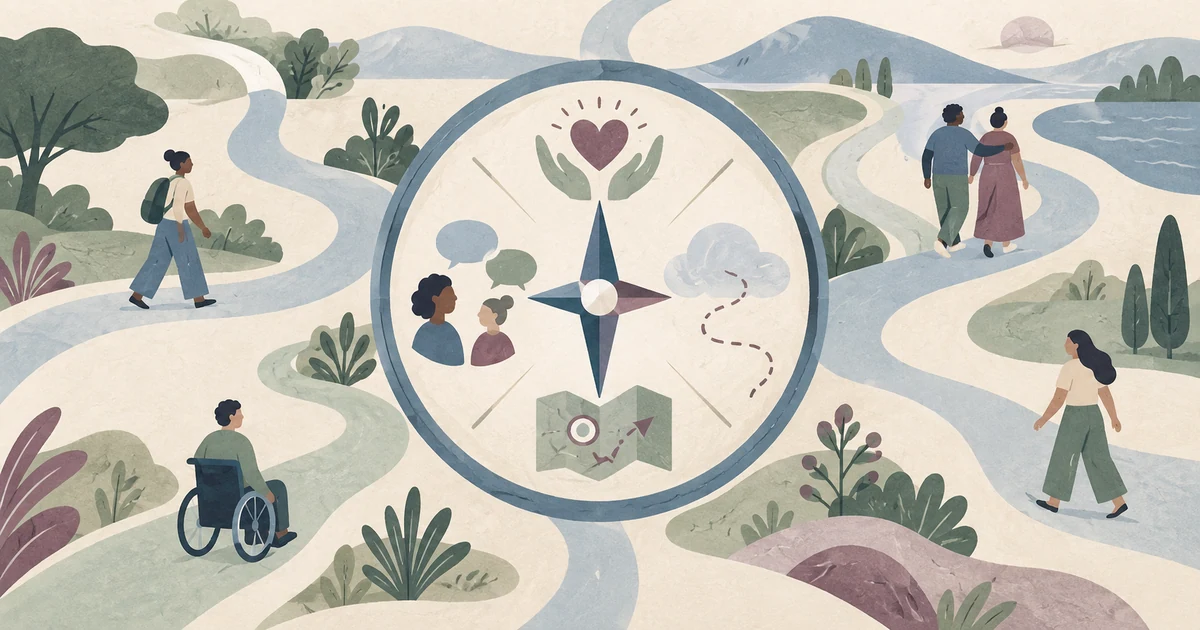
The Story Compass turns one person's account into flexible ideas and questions, not a prediction.
Read positive birth stories for ideas about care, communication and what matters to you. Do not read them as promises. One person's account cannot show that a technique caused the outcome or predict how your labour will unfold.
Take away a clearer preference or a better question. A story should not make you feel that there is one correct way to give birth, or that copying somebody else's choices will secure the same outcome.
Look beyond the ending
A story may still contain something positive when the birth did not end exactly as the person hoped. Perhaps they felt listened to, received clear explanations, had supportive people nearby or stayed involved when plans changed. Those details may help you prepare more than the final route of birth.
This broader view fits WHO's emphasis on woman-centred care through a holistic, human-rights-based approach. A positive experience is not tied to one clinical outcome, and the guidance does not promise that care will unfold in a particular way.
Use the four-question Story Compass
After reading or listening to a story, pause before opening another. Ask four questions to separate practical preparation from predictions about your own birth.
-
What mattered to this person? Look beneath the details for the value involved, such as privacy, mobility, quiet, clear information, reassurance, involvement in decisions or support from a chosen companion.
-
What support or communication helped? Notice the practical details. Were explanations offered? Was there time for questions? Did the person use agreed words or signals with someone supporting them?
-
What was personal or uncertain? Keep the sequence, sensations, timings, clinical circumstances and outcome of this account separate from ideas you could discuss or adapt.
-
What preference or question will you take with you? Turn one observation into flexible wording for your notes or a question for your maternity team.
Check whether the context matches yours
Before taking a lesson from a story, look at the context the person has shared. Was it their first birth? What setting had they planned? Which services were available, what did they prefer and did anything change? If a detail is missing, leave the gap open rather than filling it in.
Context matters in formal guidance too. NICE describes differences associated with planned birth settings for a specifically defined group: low-risk nulliparous women. That does not turn the statement into a prediction for everyone or prove that the setting alone caused one person's outcome.
Let the story point you towards something you want to understand, then ask how it applies to you. WHO presents its recommendations as guidance for policies and clinical protocols, not individualized instructions. Decisions about your care need your clinical context and a conversation with qualified maternity professionals.
Turn inspiration into flexible preparation
Do not copy somebody else's plan. Instead, take a value, a flexible preference or a question from their story.
-
The person valued being told what was happening before each change.
-
Underneath that detail was a wish for clear communication and involvement.
-
A flexible preference might be: when possible, please explain proposed changes and give me time to ask questions.
-
You might ask the care team: how are options usually explained if circumstances change quickly?
The same approach can help with movement, lighting, privacy, pain-relief discussions, support people or the atmosphere around you. Keep the wording flexible so there is room for clinical advice and changing circumstances.
Balance the stories you consume
A mix of stories is more helpful than a stream centred on one ideal ending. Include accounts with different settings, changes of plan and kinds of support. You do not need to rehearse every possibility. Notice instead how communication, dignity and personal priorities can matter across different birth pathways.
Be wary when a story credits one purchase, practice or decision for the whole outcome. Be equally cautious if it presents intervention as failure, shames people because their plans changed or promises that certain steps will avoid pain, intervention or complications. One account cannot support those conclusions.
When stories make fear louder
You do not have to keep reading material that leaves you distressed or caught in repeated searching. Pause and step away from the feed. When you feel ready, try a neutral preparation task, such as writing down one question for your next appointment.
If fear feels persistent, overwhelming or hard to manage, an article or collection of stories is not enough. Contact your midwife, maternity team, GP or local maternity service for individual support. Healthier Together also has a dedicated starting page for people who are pregnant and very worried about giving birth.
Keep one useful thing
You do not need to find a lesson in every story. Keep one thing that helps: a value you want respected, a form of support you may prefer or a question you want to ask. Leave the rest with the person whose story it is.
A positive birth story can show you different ways that care and support might look. It cannot promise anything about your body, your baby or your outcome.
Birth stories are treated as anecdotes, not evidence that a technique, setting or choice causes a particular outcome.
The supplied Healthier Together extract did not contain detailed body guidance, so the draft identifies it only as a dedicated worried-about-birth resource.
The NICE passage supports one setting comparison for low-risk nulliparous women and must not be generalized to every person, setting or outcome.
The article makes no claim that hypnobirthing, relaxation or reading positive stories prevents complications, removes pain or avoids intervention.
The article cannot verify the accuracy, completeness or representativeness of individual stories encountered elsewhere.
Sources
- WHO intrapartum care recommendations
- NICE intrapartum care guidance
- Healthier Together: worried about giving birth
This article provides general preparation information and is not individualized medical advice.
The hero is an editorial illustration, not a real birth, client story, clinical record or product result.
Editorial AI illustrations are generated for explanation and are not photographs of real events or verified product results.