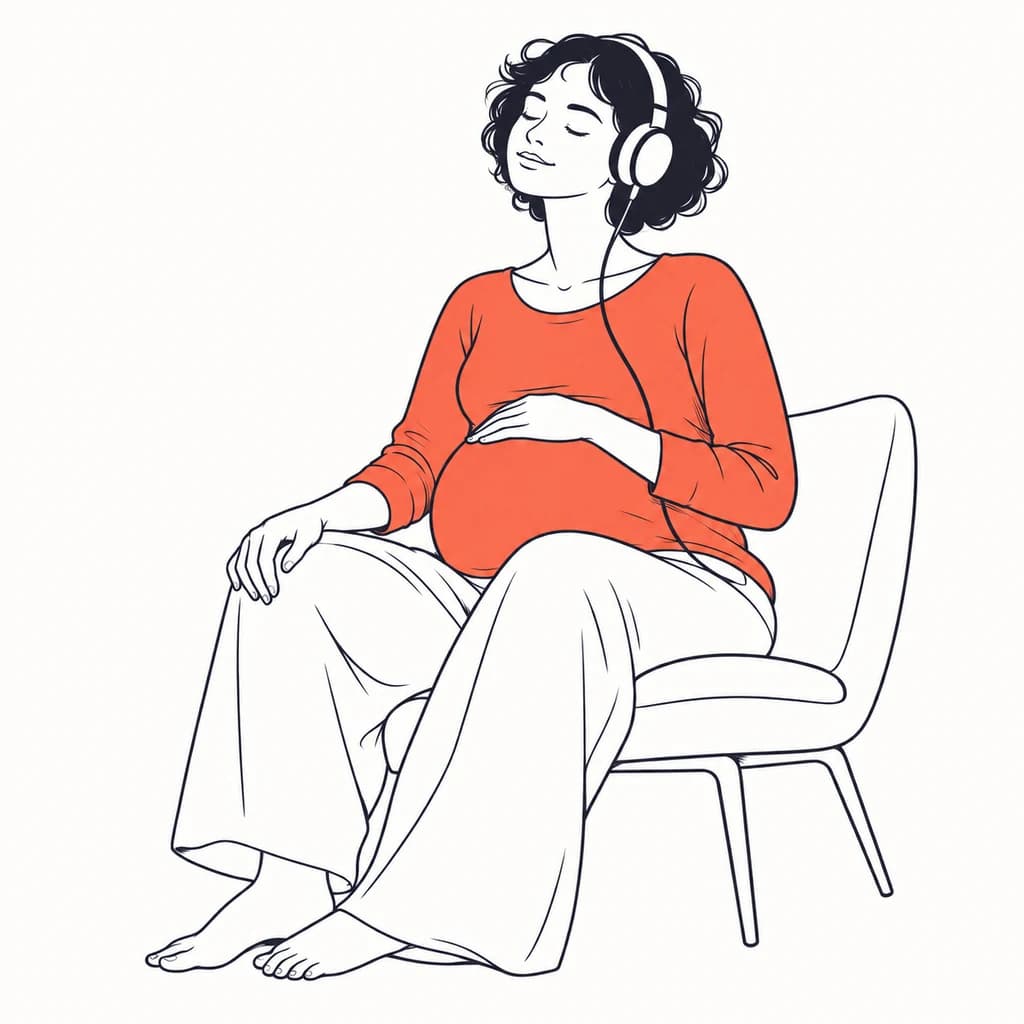
Arriving and settling
Welcome to this space of rest. This is your Calm Labour Foundation.
Take a few moments to prepare your surroundings. For this little while, you can draw a gentle boundary around yourself. Let the outside world wait while you make space for your own comfort and for the baby you are preparing to meet.
Adjust your position until you feel supported. You might lie on your side with a pillow between your knees, or rest in a semi-reclined position with cushions around you. Let the surface beneath you carry as much of your weight as it comfortably can.
If you would like to close your eyes, imagine drawing the curtains on the day: on the to-do list, on other people’s opinions, on anything that does not need your attention right now. Turn towards a quieter inner space.
Breathing with the feather
Begin by noticing the breath you already have. There is nothing to correct. Feel the air arriving, and feel it leaving again.
Now picture a feather floating just in front of your lips. If it feels comfortable, breathe in gently through your nose. As you breathe out, imagine keeping the feather in the air with a soft, steady stream of breath. There is no need to empty your lungs or make the exhale last.
Try that once more in your own time: an easy breath in, followed by a smooth and unforced breath out. You might imagine breathing in a little space and letting some tension leave with the exhale.
Notice what this pace is like for you today. Perhaps your shoulders settle. Perhaps your thoughts remain busy. Both are allowed. The breath is an invitation to return to this moment, not a test you have to pass.
A whole-body softening
Imagine a warm, golden light at the crown of your head. Let it move slowly across your scalp and forehead, smoothing the space between your eyebrows.
Allow that warmth to pass around your eyes and cheeks. Unclench your teeth if that feels good. Let your tongue rest and your jaw hang a little more loosely, simply because softness may be comfortable.
Follow the warmth down the back of your neck and across your shoulders. If you notice them lifting, see whether they would like to drop a little. There is no perfect amount of relaxation to reach.
Let the image travel through your arms, elbows, wrists and hands. Picture your hands like open blossoms: resting, unhurried and free from anything they do not need to hold.
Bring your attention to your chest and the natural rhythm beneath it. Then let the warmth move across your belly. You might place a hand there, or simply picture offering yourself and your baby a quiet moment together.
Let the light continue around your hips and pelvis, then down through your thighs, knees, calves, ankles and feet. Instead of trying to make anything happen, notice where the body already feels supported.
Your whole body may feel heavier or quieter now. Or you may simply be a little more aware of it. Whatever you notice is enough.
The path into deeper rest
Imagine yourself at the top of a gentle grassy slope beneath a clear blue sky. A path winds down through soft grass, with the scent of lavender and earth in the air.
Count slowly from ten towards one. With each number, picture one easy step along the path. Ten, beginning. Nine, sunlight on your shoulders. Eight, fresh air. Seven, nowhere else to be. Six, halfway down. Five, another steady step. Four, a little quieter. Three, supported. Two, almost there. One, arriving at a peaceful place at the foot of the hill.
Stay here for a few breaths. You do not need to become completely calm. Let this imagined place simply give your attention somewhere gentle to rest.
Meeting the waves
From this quiet place, picture warm ocean water holding you. Above you is an open sky. Around you, the water rises and settles in its own rhythm.
Notice a swell beginning in the distance. Use it as an image for a labour sensation: something that may build, reach a peak and pass. Real sensations vary, and they may be intense or painful. You do not have to pretend otherwise.
As the imagined wave approaches, see whether you can let the water support you. Breathe in whatever way feels manageable. On the out-breath, you might soften your shoulders or unclench your hands. If fighting the image feels more honest today, let that be allowed too.
The wave reaches its height and then begins to move on. Between one wave and the next, picture a stretch of calmer water. Perhaps you rest, change position, take a drink, speak to your support person or ask for the help you want.
When another swell appears, meet only this one. You might say: ‘One breath. One moment. I can choose what I need.’ Relaxation is one option among many; using pain relief or changing your plan is never a failure.
Words to carry with you
Let the following words pass through your mind. Keep the ones that feel supportive and leave the rest.
I can return to my breath. I can soften without forcing. I can ask for information, comfort and care. I can meet one moment at a time. My choices matter. I am allowed to change my mind. I can be strong and still need support.
Imagine yourself in a future birthing space. See the details that would help you feel more at ease: perhaps lower voices, familiar music, movement, water, a trusted person nearby or space to concentrate. Picture yourself communicating what you want as the moment changes.
A sensation begins. You notice it. Perhaps your shoulders drop and your jaw softens. Perhaps you move, make sound or reach for support. You do not have to look calm for this practice to be useful. You are simply rehearsing a way to come back to yourself.
Returning to the room
When you are ready, bring your attention back to the surface beneath you and the sounds in the room. Feel the weight of your limbs and the temperature of the air.
Take a comfortable breath. Wiggle your fingers and toes. Stretch if you would like to. Open your eyes in your own time, carrying forward anything from this practice that felt useful. Welcome back.