Soft and strong
Welcome to Riding Strong Waves. This session makes room for power: for moments that demand your attention and for the many ways you may respond.
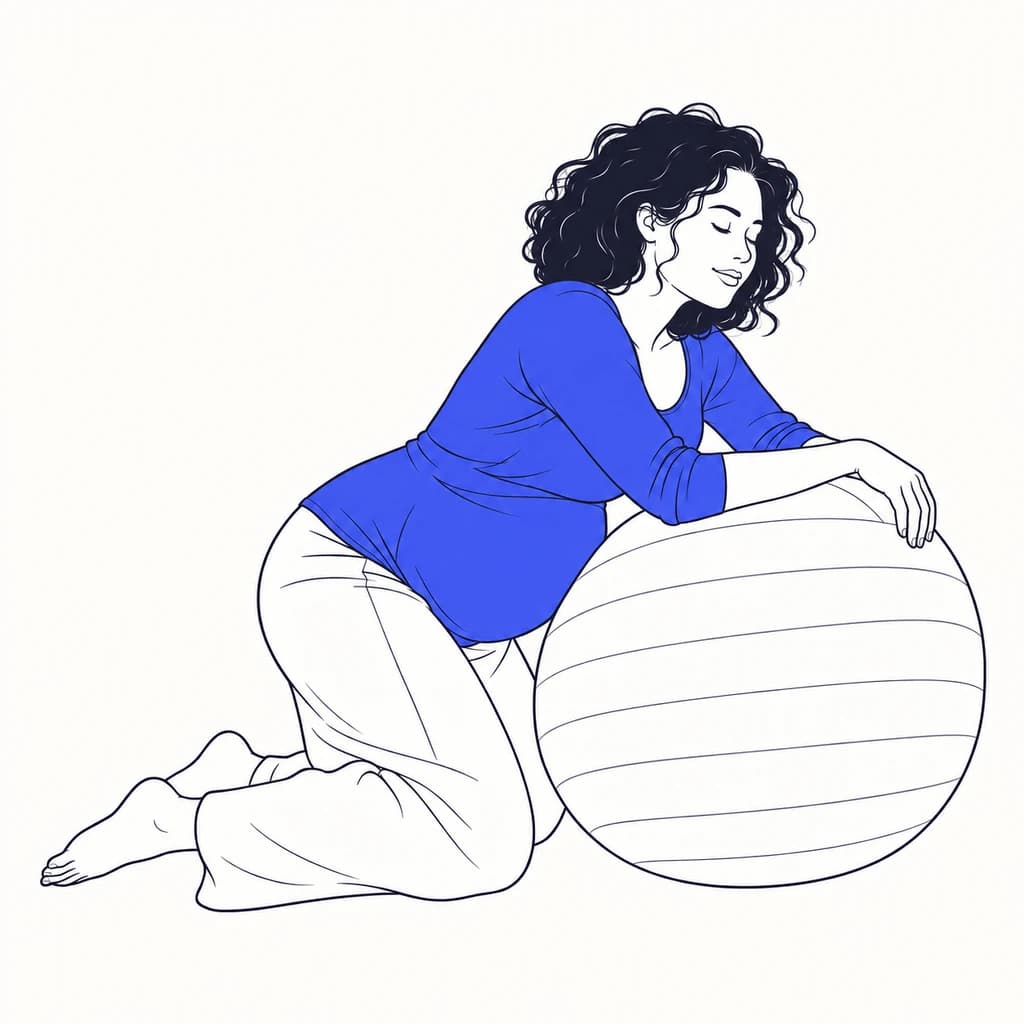
Choose a position that feels steady—sitting, kneeling, lying on your side or something else. Picture roots reaching from your hips into the ground. Let your shoulders, hands and toes move out of any bracing you notice, without treating tension as failure.
Strength does not have to mean staying quiet, still or unmedicated. It can look like movement, sound, asking for information, accepting help or saying that you want something to change.
An anchor breath, if it fits
Notice the breath you have. If a slightly longer exhale feels comfortable, try an easy count in and an unhurried count out. Stop counting before you feel breathless, light-headed or strained.
Imagine the breath as a boat rather than a rule. It may give your attention somewhere to return, but you can also breathe noisily, quickly or in another rhythm. There is no single correct breath for labour.
On an out-breath, picture your shoulders lowering and your hands opening. If those cues do not help, let them go and choose movement, voice, touch or another point of focus.
Meeting the storm
Picture a storm arriving over the sea: deep purple sky, wind and distant thunder. You stand somewhere sheltered, able to watch its scale without needing to become the weather.
An imagined wave begins. Let your spine lengthen or your body curl—whichever feels right. Breathe in a manageable way. At the height of the sensation, picture a quiet centre within the storm while allowing the outside to be loud and difficult.
The wave breaks and moves away. Let your body reset in its own time. Strong intensity can occur for different reasons and does not prove that birth is nearly complete. Your care team can help you understand what is happening.
The surfer and the mountain
Now imagine a surfer turning towards shore as a large swell arrives. They do not control the ocean; they respond to the water beneath them. Picture finding your own responsive posture as a second wave builds.
Call the sensation whatever is honest: pressure, pain, tightening, power or simply ‘this wave.’ There is no need to replace one word with another. Use your anchor, ask for support and meet only the part that is here now.
If a thought such as ‘I cannot do this’ appears, do not use it to diagnose transition or progress. Let it be a real request for care. Someone can offer reassurance, information, a new comfort measure or pain relief.
The lighthouse
Picture your support person as a lighthouse on solid rock. Their light is steady, but you decide whether to look towards it. They can breathe nearby, meet your eyes, offer a hand or give you space.
Choose believable words: I can do the next part with support. My breath is one option. I can name pain. I can ask for more help. I do not have to prove my strength.
Let the storm clear in your imagination. Feel the real support beneath you and return to an easy breathing rhythm. Move your hands and feet, notice the room and open your eyes when ready.